Few cities on earth carry a history as brutal, as improbable, and ultimately as alive as Phnom Penh. A city emptied in a single morning. A city that chose, somehow, to return.
A City Born from Legend
The story begins, as so many Khmer stories do, with a woman and a river. Around 1372, an elderly woman named Daun Penh — literally "Grandmother Penh" — lived on the banks of the Tonlé Sap. Legend has it she spotted a koki tree floating downstream carrying four bronze Buddha statues and one stone Buddha. She retrieved them, placed them atop the nearby hill, and built a temple to house them.
That hill — Phnom, meaning "hill" in Khmer — became the symbolic heart of a city. The name has never changed: the city of Phnom Penh is, still today, "the hill of Grandmother Penh."
In 1434, King Ponhea Yat moved the Khmer capital here from Angkor, which was increasingly threatened by Siamese raids. Phnom Penh grew into a significant trading hub, positioned at the confluence of the Mekong, Tonlé Sap, and Bassac rivers — a natural crossroads where Chinese, Cham, Malay, and later European merchants gathered.
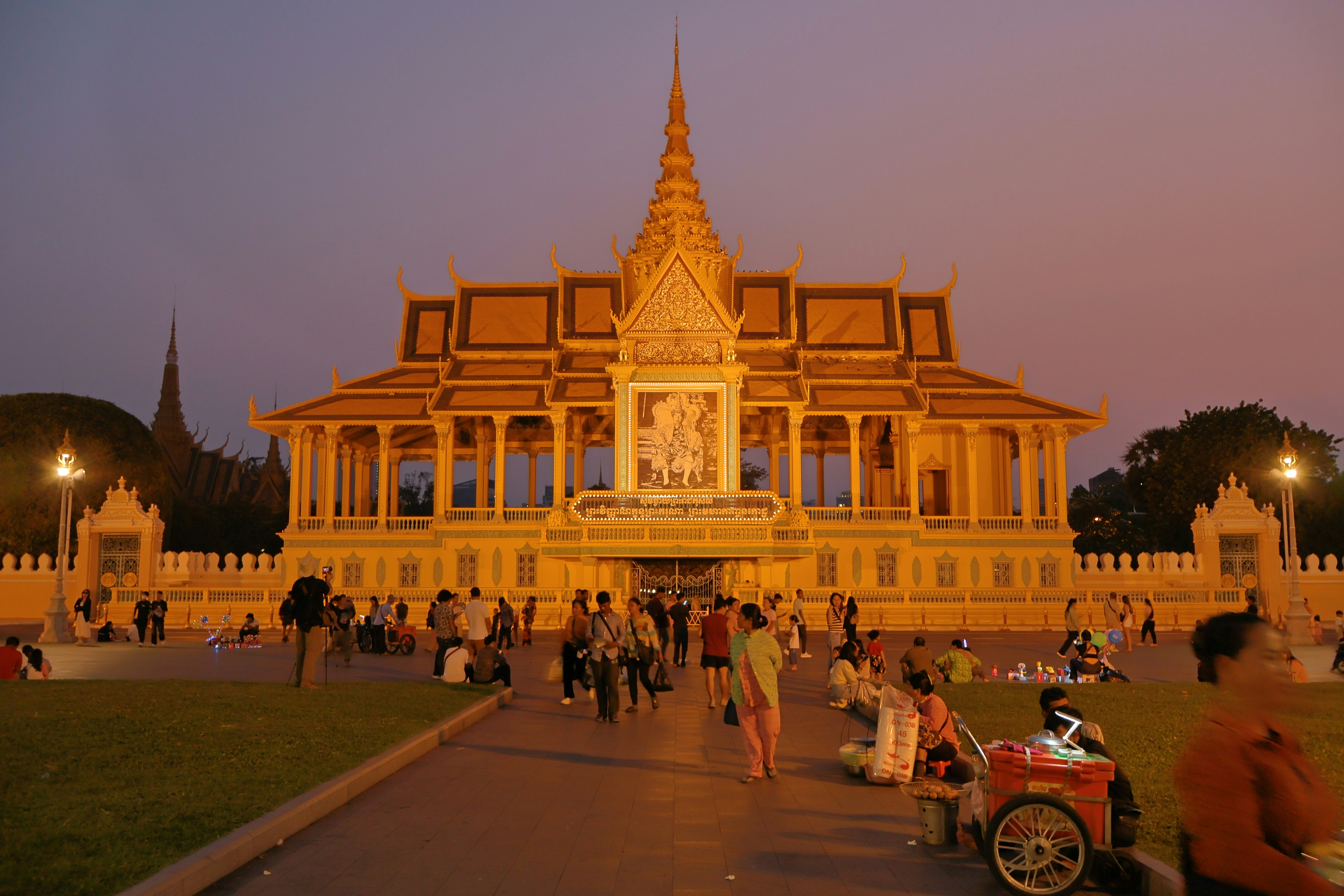
The Tonlé Sap riverfront — the waterway that shaped the city's destiny
Colonial Reinvention
The French arrived in force in 1863. Cambodia became a protectorate, and Phnom Penh their chosen capital. What followed was a dramatic urban reimagination: wide boulevards cut through the existing fabric, a central market, a royal palace rebuilt in imperial French-Khmer hybrid style, tree-lined avenues, and grand administrative buildings designed to project power.
The French left a complicated legacy. Much of what visitors call "beautiful" in Phnom Penh today — the riverfront promenade, the Sisowath Quay architecture, the Psar Thmei (Central Market) with its art deco dome — is this colonial layer. Yet the expansion also displaced thousands, systematically erased neighborhoods, and restructured Cambodian society around French administrative needs.
By the 1950s and 1960s, under the rule of Prince Norodom Sihanouk, the city entered a golden age. The New Khmer Architecture movement flourished — a bold, modernist style blending Corbusier with traditional Khmer forms, led by architect Vann Molyvann. The Olympic Stadium, the Institute of Foreign Languages, the Council of Ministers building — many of these structures still stand, awaiting recognition they deserve.
The Morning of April 17, 1975
At dawn on April 17, 1975, the Khmer Rouge entered Phnom Penh. The population — swollen to nearly 2 million by refugees fleeing the countryside — were told the Americans were about to bomb the city, and they needed to evacuate for "two or three days."
Within hours, a city of two million was empty.
Hospitals were cleared. Patients on operating tables were wheeled into the streets. Diplomats were expelled. Monks were defrocked. The city's entire population — the sick, the elderly, newborns — was marched into the countryside.
For four years, the city stood largely silent. Streets filled with abandoned cars, rotting food, empty apartments. Phnom Penh became perhaps the largest ghost city of the 20th century — emptied not by plague or disaster, but by ideology.
Daun Penh discovers Buddha statues in the river. A temple is built atop the hill. The legend of Phnom Penh begins.
King Ponhea Yat moves the Khmer capital from Angkor to Phnom Penh, making it the permanent seat of power.
France establishes a protectorate over Cambodia. Phnom Penh is redesigned along colonial lines — boulevards, the Royal Palace, art deco buildings.
Independence from France. The city enters its golden era under Prince Sihanouk. Architecture flourishes.
April 17: Khmer Rouge forces march in. The entire city is evacuated in a single day. Phnom Penh falls silent.
Vietnamese forces liberate the city. Survivors begin returning to find their homes occupied or destroyed. The long rebuilding begins.
Rapid development, foreign investment, and a chaotic reconstruction. The city expands outward. The wounds remain visible beneath the surface.
A city of 2.5 million, one of the fastest-growing capitals in Southeast Asia. Still raw. Still healing. Completely, impossibly alive.
Return and Reinvention
Vietnamese forces entered the city on January 7, 1979. The Khmer Rouge fled. And slowly, survivors began returning — to a city they barely recognized. Homes had been claimed. Families were scattered across mass graves and jungle camps. Entire professions had been decimated: doctors, teachers, engineers, lawyers — nearly wiped out.
The rebuilding was chaotic, painful, and extraordinary. In the 1980s, under Vietnamese administration, the city began to function again — a skeleton of its former self, but alive. The 1990s brought the UN transitional period, an influx of NGOs, and the first foreign investors. With them came construction cranes, international restaurants, and a complicated kind of prosperity.
Phnom Penh Today
Today the city holds 2.5 million people and growing. Glass towers rise over French villas. A Starbucks occupies a colonial corner. Tuk-tuks weave between Lexus SUVs. The night markets sell both freshly grilled insects and artisanal cocktails.
What makes Phnom Penh unlike any other Southeast Asian capital is this layering — royal, colonial, traumatic, resilient — compressed into a relatively small, navigable city. The Tuol Sleng Genocide Museum sits ten minutes from a rooftop bar. The killing fields are a 20-minute tuk-tuk ride from luxury hotels. Survivors of the regime are still alive — elderly women selling noodles at dawn, men missing limbs who remember what silence sounds like when 2 million people are gone.
You cannot understand Cambodia without sitting with this. The city is not asking you to be comfortable. It is asking you to be present.
Phnom Penh is not a postcard. It's a witness. Come with open eyes.
Peu de villes au monde portent une histoire aussi brutale, aussi improbable, et finalement aussi vivante que Phnom Penh. Une ville vidée en une seule matinée. Une ville qui a choisi, malgré tout, de revenir.
Une ville née d'une légende
L'histoire commence, comme tant d'histoires khmères, avec une femme et un fleuve. Vers 1372, une vieille dame prénommée Daun Penh — littéralement "Grand-mère Penh" — vivait sur les rives du Tonlé Sap. La légende raconte qu'elle aperçut un arbre koki flottant à contre-courant, portant quatre statues de Bouddha en bronze et une en pierre. Elle les récupéra, les plaça au sommet de la colline voisine, et y construisit un temple.
Cette colline — Phnom, en khmer — est devenue le cœur symbolique d'une ville. Son nom n'a jamais changé : la ville de Phnom Penh est, encore aujourd'hui, "la colline de Grand-mère Penh."
En 1434, le roi Ponhea Yat déplaça la capitale khmère d'Angkor vers Phnom Penh, de plus en plus menacée par les raids siamois. La ville devint un important carrefour commercial, idéalement située à la confluence du Mékong, du Tonlé Sap et du Bassac.
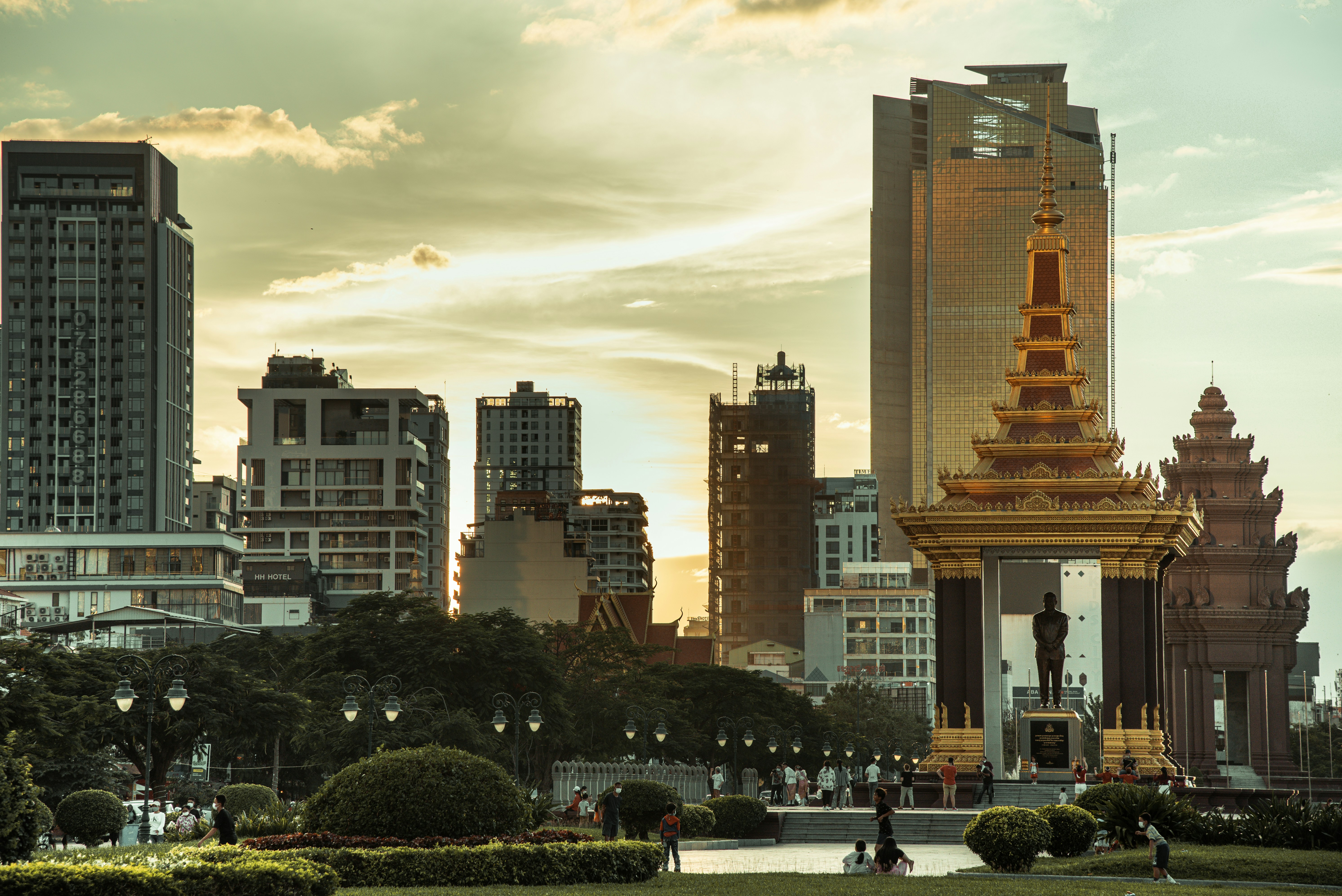
Le front de mer du Tonlé Sap — le fleuve qui a façonné le destin de la ville
La réinvention coloniale
Les Français s'installèrent durablement en 1863. Le Cambodge devint un protectorat, Phnom Penh leur capitale choisie. Ce qui suivit fut une transformation urbaine radicale : grands boulevards, marché central, palais royal reconstruit dans un style franco-khmer, avenues plantées d'arbres. Un Phnom Penh pensé pour incarner la puissance coloniale.
Les Français ont laissé un héritage complexe. Ce que les visiteurs qualifient de "beau" à Phnom Penh — la promenade du quai Sisowath, le marché central avec son dôme Art déco, les villas coloniales — appartient à cette couche historique. Mais cette expansion a aussi déplacé des milliers de personnes et restructuré la société cambodgienne au profit de l'administration française.
Dans les années 1950-60, sous le prince Norodom Sihanouk, la ville connut un âge d'or. Le mouvement de la Nouvelle Architecture Khmère éclot — un style moderniste audacieux mêlant Corbusier et formes khmères traditionnelles, porté par l'architecte Vann Molyvann. Le stade olympique, l'Institut des langues étrangères, le Conseil des ministres — beaucoup de ces bâtiments existent encore.
Le matin du 17 avril 1975
À l'aube du 17 avril 1975, les Khmers rouges entrent dans Phnom Penh. La population — gonflée à près de 2 millions de personnes par les réfugiés fuyant la campagne — est informée que les Américains s'apprêtent à bombarder la ville, et qu'il faut évacuer "deux ou trois jours."
En quelques heures, une ville de deux millions d'habitants est vide.
Les hôpitaux sont vidés. Des patients sur les tables d'opération sont poussés dans la rue. Les diplomates sont expulsés. Les moines sont défroqués. Toute la population — malades, personnes âgées, nouveau-nés — est chassée vers les campagnes.
Pendant quatre ans, la ville resta largement silencieuse. Phnom Penh devint peut-être la plus grande ville fantôme du XXe siècle — vidée non par une épidémie ou une catastrophe, mais par une idéologie.
Phnom Penh aujourd'hui
Aujourd'hui, la ville compte 2,5 millions d'habitants, en constante croissance. Des tours de verre s'élèvent au-dessus des villas françaises. Un Starbucks occupe un coin colonial. Des tuk-tuks se faufilent entre des SUV Lexus. Les marchés nocturnes vendent aussi bien des insectes grillés que des cocktails artisanaux.
Ce qui rend Phnom Penh unique parmi les capitales d'Asie du Sud-Est, c'est ce millefeuille historique — royal, colonial, traumatique, résilient — compressé dans une ville relativement petite et accessible. Le musée du génocide de Tuol Sleng est à dix minutes d'un bar sur les toits. Les champs de la mort se trouvent à vingt minutes en tuk-tuk des hôtels de luxe. Les survivants du régime sont encore en vie — des vieilles femmes qui vendent des nouilles à l'aube, des hommes dont les yeux portent le souvenir du silence quand 2 millions de personnes disparaissent.
On ne comprend pas le Cambodge sans s'asseoir avec tout ça. La ville ne cherche pas à vous mettre à l'aise. Elle vous demande d'être présent.
Phnom Penh n'est pas une carte postale. C'est un témoin. Venez les yeux ouverts.
Kaum eine Stadt der Welt trägt eine so brutale, so unwahrscheinliche und am Ende so lebendige Geschichte wie Phnom Penh. Eine Stadt, die an einem einzigen Morgen geleert wurde. Eine Stadt, die sich entschied zurückzukehren.
Eine Stadt, geboren aus einer Legende
Die Geschichte beginnt, wie so viele Khmer-Geschichten, mit einer Frau und einem Fluss. Um 1372 lebte eine alte Frau namens Daun Penh — wörtlich "Großmutter Penh" — am Ufer des Tonlé Sap. Der Legende nach entdeckte sie einen Koki-Baum, der flussaufwärts trieb und vier bronzene Buddhastatuen sowie eine aus Stein trug. Sie barg sie, stellte sie auf den nahen Hügel und baute einen Tempel.
Dieser Hügel — Phnom, Khmer für "Hügel" — wurde zum symbolischen Herz einer Stadt. Der Name hat sich nie geändert: Die Stadt Phnom Penh ist noch heute "der Hügel der Großmutter Penh."
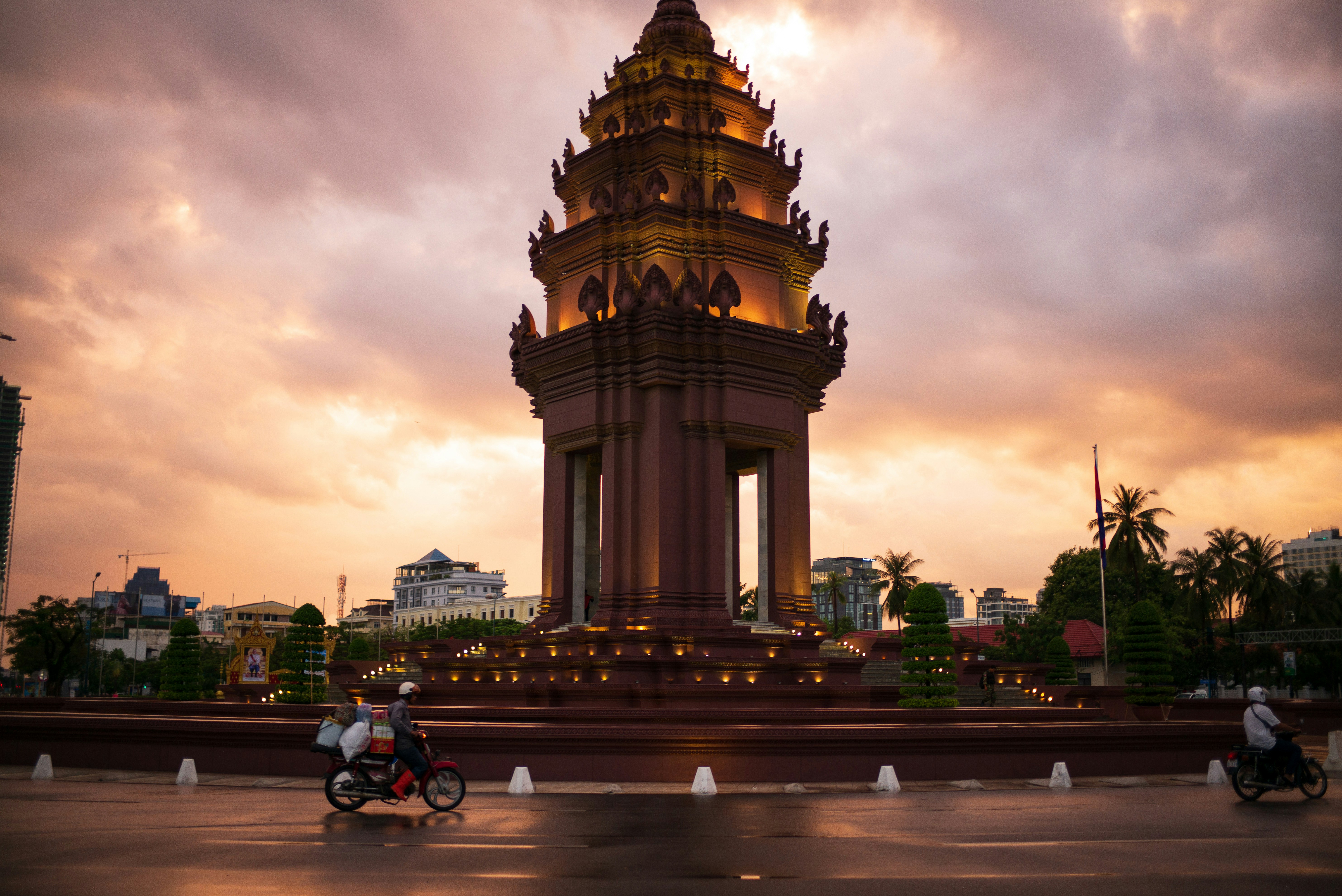
Das Tonlé Sap-Ufer — das Gewässer, das das Schicksal der Stadt geprägt hat
Der 17. April 1975
Im Morgengrauen des 17. April 1975 marschierten die Roten Khmer in Phnom Penh ein. Der Bevölkerung — auf fast 2 Millionen Menschen angewachsen durch Flüchtlinge vom Land — wurde gesagt, die Amerikaner würden die Stadt bombardieren, man müsse "zwei oder drei Tage" evakuieren.
Innerhalb weniger Stunden war eine Stadt von zwei Millionen Menschen leer.
Krankenhäuser wurden geräumt. Patienten auf OP-Tischen wurden auf die Straße gerollt. Diplomaten wurden ausgewiesen. Mönche wurden entmöncht. Die gesamte Bevölkerung — Kranke, Alte, Neugeborene — wurde aufs Land getrieben.
Vier Jahre lang war die Stadt weitgehend still. Phnom Penh wurde vielleicht zur größten Geisterstadt des 20. Jahrhunderts — nicht durch Seuche oder Katastrophe geleert, sondern durch Ideologie.
Phnom Penh heute
Heute zählt die Stadt 2,5 Millionen Einwohner, Tendenz steigend. Glastürme erheben sich über französischen Villen. Ein Starbucks belegt eine Kolonialecke. Tuk-Tuks schlängeln sich zwischen Lexus-SUVs hindurch. Auf den Nachtmärkten gibt es frisch gegrillte Insekten neben Craft-Cocktails.
Was Phnom Penh von allen anderen südostasiatischen Hauptstädten unterscheidet, ist diese Schichtung — königlich, kolonial, traumatisch, resilient — verdichtet in einer relativ kleinen, begehbaren Stadt. Das Völkermordmuseum Tuol Sleng liegt zehn Minuten von einer Dachbar entfernt. Die Killing Fields sind eine 20-minütige Tuk-Tuk-Fahrt von Luxushotels entfernt. Überlebende des Regimes leben noch — alte Frauen, die im Morgengrauen Nudelsuppe verkaufen, Männer, deren Augen sich an die Stille erinnern, als zwei Millionen Menschen verschwanden.
Phnom Penh ist keine Postkarte. Es ist ein Zeuge. Kommen Sie mit offenen Augen.