Ask most food tourists to name the great cuisines of Asia and they'll say Japanese, Chinese, Thai, Vietnamese, Indian. Cambodia rarely makes the list. This is a mistake of spectacular proportion.
The Foundation: Kroeung and Prahok
Cambodian cooking is built on two pillars that have no real equivalent elsewhere: kroeung and prahok.
Kroeung is a fresh paste — made from lemongrass, galangal, kaffir lime leaves, turmeric, shallots, and garlic — that forms the aromatic base of most Khmer dishes. Unlike Thai curry pastes which tend toward intensity, kroeung is subtler, more herbaceous, more concerned with perfume than heat. Every cook makes it slightly differently. Every family has a version that has been passed down for generations.
Prahok is fermented fish paste — Cambodia's fish sauce equivalent, except that calling it that does it no justice. Fermented for months or years in clay jars, with a smell that can clear a room but a flavor that provides an umami depth unlike anything in the Thai, Vietnamese, or Lao culinary vocabularies. It is the backbone. The thing that makes Cambodian food taste Cambodian.
A Phnom Penh market at dawn — where the real Cambodian kitchen starts
The Dishes You Need to Know
- Fish Amok Cambodia's national dish. A delicate fish mousse steamed in banana leaves with a kroeung base and coconut milk. Light, aromatic, complex. The fine version — amok trey — is nothing like the restaurant versions served to tourists. Find it at a wedding or a family table.
- Num Banh Chok Rice noodles served cold with a fresh fish-based green curry, topped with raw vegetables, banana flower, and bean sprouts. The true Cambodian breakfast — eaten at dawn, standing, from a woman with a pot on the roadside. One of the world's great morning meals.
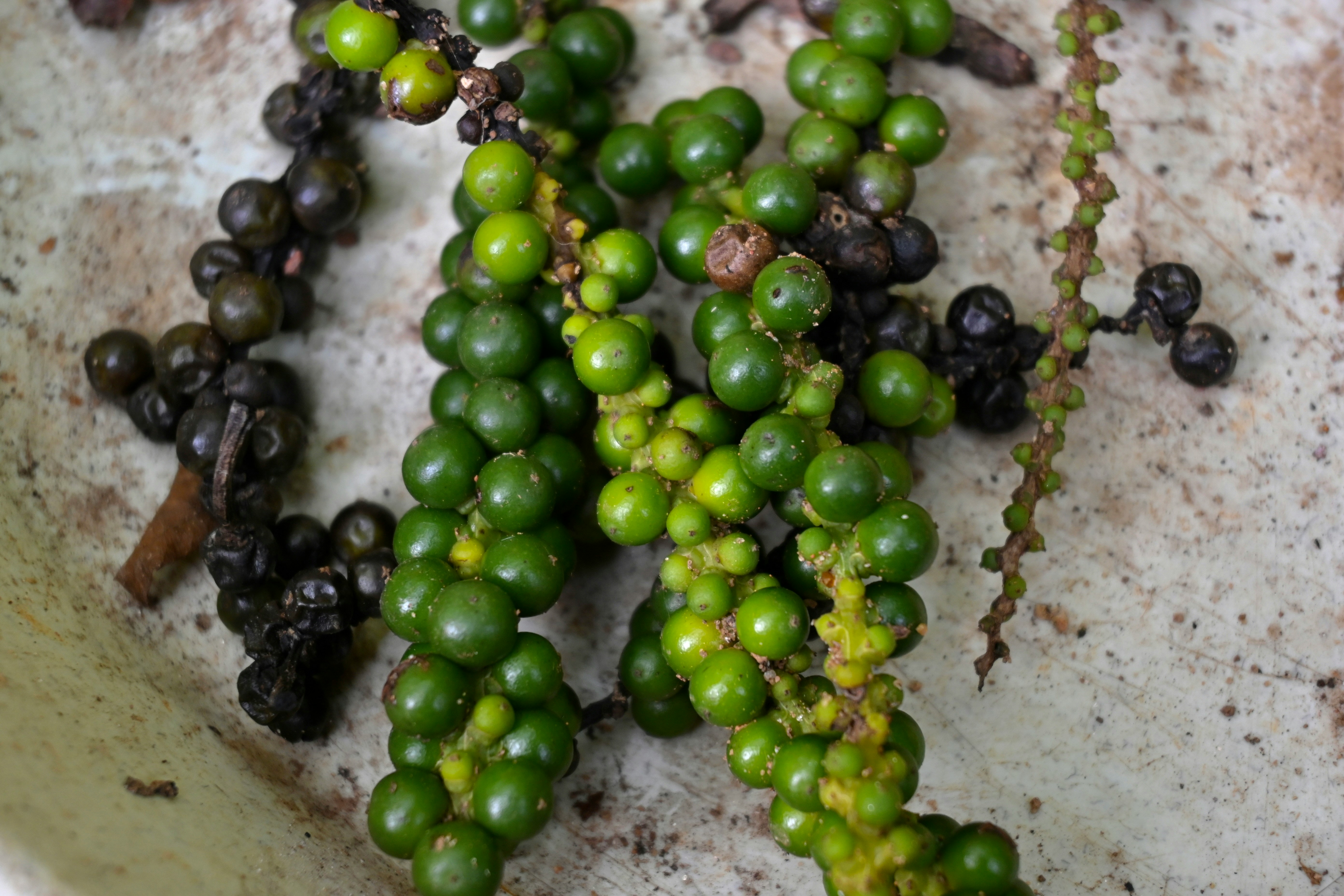
- Lok Lak Stir-fried beef or pork served on a bed of lettuce and tomato with a dipping sauce of Kampot pepper, lime juice, and salt. The pepper sauce is the point. Without genuine Kampot pepper, this dish is ordinary. With it, it becomes a study in restraint.
- Samlor Machu A sour soup — Cambodia's answer to tom yum — made with fish or pork, pineapple, tomatoes, and tamarind. The sourness is brighter and cleaner than its Thai equivalent. Often eaten for breakfast with rice.
- Kuy Teav Rice noodle soup, the Cambodian equivalent of pho. Clear pork-based broth, rice noodles, bean sprouts, herbs, a squeeze of lime. Served at street stalls from 5am. The correct hangover cure. The incorrect thing to dismiss as "just noodle soup."
- Banana Flower Salad Thinly sliced banana blossom dressed with fish sauce, lime, chili, mint, and either shrimp or chicken. A study in texture — tender, crisp, chewy all at once. Often served with num banh chok. Beautiful to eat.
The Mekong and the Tonlé Sap
The geography of Cambodia determines its cuisine. The country sits at the intersection of two extraordinary water systems: the Mekong River and the Tonlé Sap lake. The Tonlé Sap is one of the most biologically rich freshwater systems on earth — during the rainy season, it produces an almost unimaginable quantity of fish.
This abundance defines the food. Fish appears in almost every form: fresh, grilled, smoked, dried, fermented. The prahok industry alone is an entire economic system — fish caught in the Tonlé Sap, salted, packed in jars, fermented for a season, and then sold at markets across the country. In a poor country in a tropical climate, fermentation solved a fundamental problem: protein preservation. In the hands of Cambodian cooks, it became an ingredient of extraordinary culinary sophistication.
Where to Eat in Phnom Penh
The best Cambodian food in Phnom Penh is not in restaurants — it is at the markets. Psar Thmei (Central Market), Psar O'Russei, and Psar Tuol Tom Pong (the "Russian Market") each have food sections where women cook and sell food made to feed Cambodians, not tourists. The portions are large, the prices are low, the flavors are real.
For restaurants: Mahob, in BKK1, does the best high-end Khmer food in the city. Romdeng specializes in traditional dishes including insects and jungle food prepared with genuine skill. Embassy Restaurant on the Mekong is the place for a proper fish amok by the water.
The coffee culture deserves a mention: Cambodian iced coffee — robusta beans, sweetened condensed milk, over crushed ice — drunk at 7am in the heat, served in a plastic bag with a straw, is one of the great simple pleasures on earth.
Eat at the market. Eat with your hands when offered. Eat the things you can't identify. That is how Cambodian food reveals itself.
Demandez à la plupart des touristes gourmands de citer les grandes cuisines d'Asie, ils diront japonaise, chinoise, thaïlandaise, vietnamienne, indienne. Le Cambodge est rarement mentionné. C'est une erreur de proportion spectaculaire.
Les bases : kroeung et prahok
La cuisine cambodgienne repose sur deux piliers sans équivalent ailleurs : le kroeung et le prahok.
Le kroeung est une pâte fraîche — citronnelle, galanga, feuilles de citron kaffir, curcuma, échalotes, ail — qui forme la base aromatique de la plupart des plats khmers. Contrairement aux pâtes de curry thaïlandaises qui tendent vers l'intensité, le kroeung est plus subtil, plus herbacé. Chaque cuisinier le fait légèrement différemment. Chaque famille a une version transmise depuis des générations.
Le prahok est une pâte de poisson fermenté — l'équivalent cambodgien de la sauce de poisson, sauf que cette description ne lui rend pas justice. Fermenté pendant des mois ou des années dans des jarres en argile, avec une odeur qui peut vider une pièce mais une saveur qui apporte une profondeur umami sans équivalent. C'est la colonne vertébrale. Ce qui rend la cuisine cambodgienne cambodgienne.
Les plats essentiels
- Fish AmokLe plat national. Une délicate mousse de poisson cuite à la vapeur dans des feuilles de bananier avec une base kroeung et du lait de coco. Léger, aromatique, complexe. La vraie version — amok trey — n'a rien à voir avec celles servies aux touristes.
- Num Banh ChokNouilles de riz froides avec un curry vert à base de poisson, surmontées de légumes crus, fleur de bananier et pousses de soja. Le vrai petit-déjeuner cambodgien — mangé à l'aube, debout, acheté à une femme avec une marmite au bord de la route.
- Lok LakSauté de bœuf ou de porc sur un lit de laitue et tomate, avec une sauce de poivre de Kampot, citron vert et sel. Sans vrai poivre de Kampot, ce plat est ordinaire. Avec, il devient une étude en retenue.
- Kuy TeavSoupe de nouilles de riz, l'équivalent cambodgien du pho. Bouillon de porc clair, nouilles de riz, pousses de soja, herbes, citron vert. Servi dès 5h du matin dans les stands de rue.
Le Mékong et le Tonlé Sap
La géographie du Cambodge détermine sa cuisine. Le Tonlé Sap est l'un des systèmes d'eau douce les plus biologiquement riches de la planète — pendant la saison des pluies, il produit une quantité de poissons presque inimaginable. Cette abondance définit la nourriture. Le poisson apparaît sous presque toutes les formes : frais, grillé, fumé, séché, fermenté.
Où manger à Phnom Penh
La meilleure cuisine cambodgienne à Phnom Penh n'est pas dans les restaurants — elle est dans les marchés. Psar Thmei, Psar O'Russei et Psar Tuol Tom Pong ont des sections alimentation où des femmes cuisinent pour nourrir des Cambodgiens, pas des touristes. Pour les restaurants : Mahob dans BKK1 propose la meilleure cuisine khmère gastronomique de la ville. Romdeng se spécialise dans les plats traditionnels incluant insectes et cuisine de jungle.
Mangez au marché. Mangez avec les mains quand on vous le propose. Mangez ce que vous ne savez pas identifier. C'est ainsi que la cuisine cambodgienne se révèle.
Fragen Sie die meisten Feinschmecker-Touristen, die großen Küchen Asiens zu nennen: Sie werden japanisch, chinesisch, thailändisch, vietnamesisch, indisch sagen. Kambodscha kommt selten vor. Das ist ein Irrtum von spektaculärem Ausmaß.
Die Grundlagen: Kroeung und Prahok
Die kambodschanische Küche basiert auf zwei Säulen ohne wirkliches Äquivalent anderswo: Kroeung und Prahok. Kroeung ist eine frische Paste — Zitronengras, Galgant, Kaffir-Limettenblätter, Kurkuma, Schalotten, Knoblauch — die die aromatische Grundlage der meisten Khmer-Gerichte bildet. Prahok ist fermentierte Fischpaste, Monate oder Jahre in Tontöpfen fermentiert, mit einem Geruch, der einen Raum leeren kann, aber einem Geschmack, der eine Umami-Tiefe ohne Vergleich bietet.
Die wichtigsten Gerichte
- Fish AmokKambodschas Nationalgericht. Zartes Fischmousse, in Bananenblättern gedämpft mit Kroeung-Basis und Kokosmilch. Leicht, aromatisch, komplex.
- Num Banh ChokKalte Reisnudeln mit einem frischen, fischbasierten grünen Curry, mit rohem Gemüse und Bananenblüte. Das echte kambodschanische Frühstück.
- Lok LakGebratenes Rind oder Schwein auf Salat und Tomaten mit einer Dip-Sauce aus Kampot-Pfeffer, Limettensaft und Salz. Der Pfeffer ist der Punkt.
- Kuy TeavReisnudelsuppe — Kambodschas Pho-Äquivalent. Klare Schweinebrühe, Reisnudeln, Sojasprossen, Kräuter, Limette. Ab 5 Uhr morgens an Straßenständen.
Essen Sie auf dem Markt. Essen Sie mit den Händen, wenn es angeboten wird. Essen Sie Dinge, die Sie nicht identifizieren können. So offenbart sich die kambodschanische Küche.